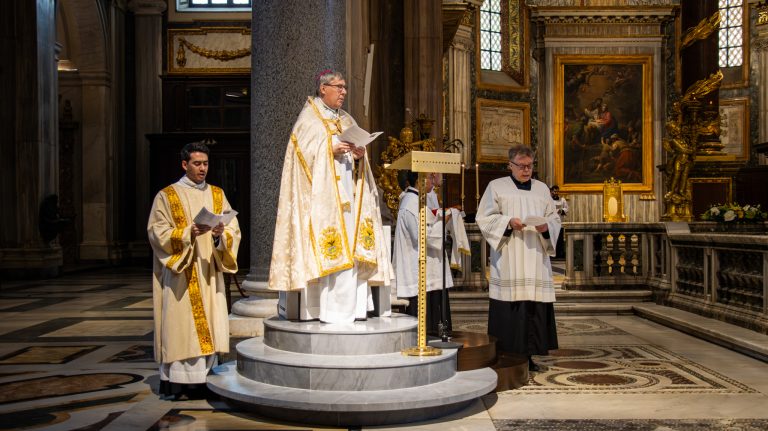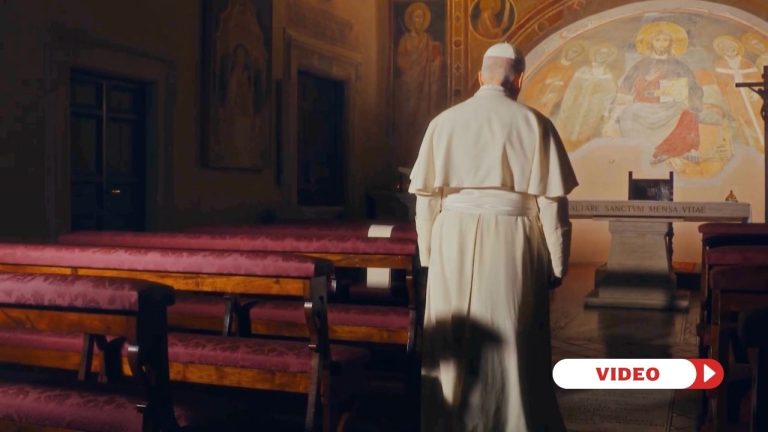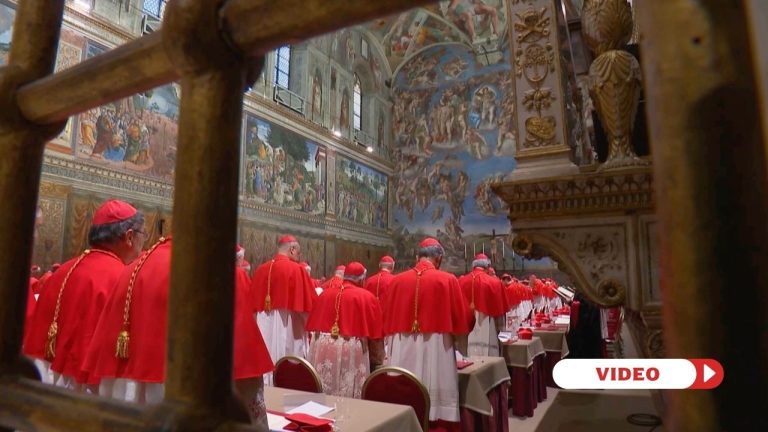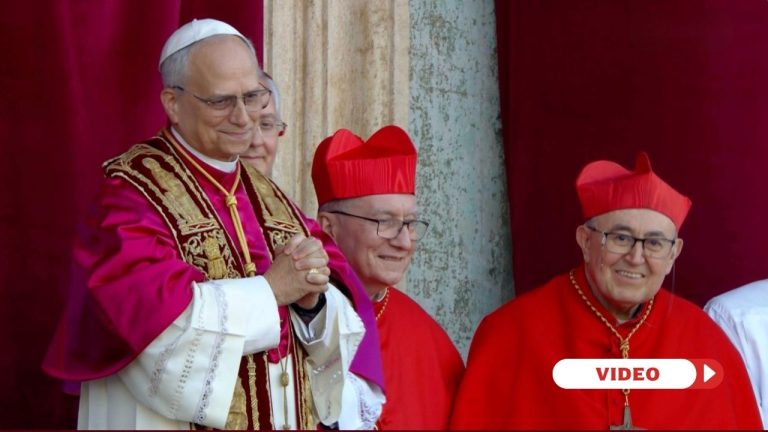


One year ago today, on 18 May 2025, Pope Leo XIV celebrated his inauguration Mass in St. Peter’s Square before some 200,000 faithful and dozens of world leaders. Ten days earlier, white smoke had risen from the Sistine Chapel, and Cardinal Robert Francis Prevost — a Chicago-born Augustinian missionary who had spent decades serving in Peru — stepped onto the balcony of St. Peter’s Basilica as the first American pope in history.
His first words to the world were simple: “La pace sia con tutti voi.” Peace be with you all.
Twelve months on, those words have proven to be more than a greeting. They have become the defining theme of a papacy that has spoken clearly and firmly into a world of war, division, and uncertainty — and into a country like Denmark, where the questions Pope Leo keeps raising are being asked with fresh urgency.
A Pope for an Uncertain World
Pope Leo XIV inherited a Church and a world under pressure. The war in Ukraine continued. Tensions in the Middle East deepened. Across Europe and North America, political polarisation widened and trust in institutions kept falling. Into this, the new pope consistently offered the same answer: peace rooted in human dignity, dialogue over confrontation, and a Church that builds bridges rather than walls.
From the beginning, Pope Leo described his vision as “a united Church” capable of becoming “a leaven for a reconciled world.” It was a vision shaped by his Augustinian spirituality, his decades of missionary life in Latin America, and his years overseeing the Dicastery for Bishops in Rome — work that gave him an unusually clear picture of the global Church, including its smallest and most isolated communities.
Communities like the Catholics of Denmark.
Key Moments of the First Year
In his first twelve months, Pope Leo moved steadily and deliberately. He made his first international apostolic journey to Turkey and Lebanon in late November 2025, marking the 1,700th anniversary of the Council of Nicaea — a reminder that the Church’s roots in faith and reason run far deeper than the divisions of the present moment.
On January 6, 2026, Pope Leo closed the Holy Door of St. Peter’s Basilica, formally concluding the 2025 Jubilee Year dedicated to hope. During the closing Mass, he spoke pointedly about the way a distorted economy tries to exploit even the human desire for joy — gifts, he said, that God offers freely to everyone.
In April, he celebrated Easter in St. Peter’s Square, led a prayer vigil for peace, and washed the feet of clergymen at Holy Thursday Mass at the Basilica of St. John Lateran. Then, on April 13, he made a historic visit to Algeria — the first ever papal visit to the country.
His first anniversary on May 8 was marked with a pilgrimage to the Marian Shrine of Pompeii. Many Catholics see his first year as the beginning of a papacy grounded not in political power, but in spiritual conviction — calm yet firm, humble yet courageous.
What It Means Here in Denmark
For Denmark’s Catholics, the first year of Pope Leo XIV’s papacy has felt both distant and surprisingly close.
Distant, because Denmark is small and far from Rome — a diocese of barely 52,000 faithful spread across one of the world’s most secular nations. The drama of Vatican politics, the pope’s tensions with the Trump White House, the global headlines — these feel remote from the daily reality of a parish in Copenhagen or Aarhus.
And yet, close — because the questions Pope Leo keeps asking are exactly the questions Denmark is wrestling with right now.
When Prime Minister Mette Frederiksen called for åndelig oprustning — spiritual rearmament — in the summer of 2025, she was acknowledging, in her own way, what Pope Leo has said from the very beginning: that military strength and political structures are not enough to sustain a society. That something deeper is needed. That peace is not just the absence of war, but the presence of something worth defending.
“Pope Leo has become the singular clarion voice in our global community about the need for peace and safeguarding human dignity,” as Washington Cardinal Robert McElroy put it. In a Denmark that is simultaneously rearming its military and searching for its soul, that voice deserves to be heard.
A Nordic Awakening?
There are signs, small but real, that something is stirring in the Nordic countries under the new pontificate.
Pope Leo’s emphasis on a missionary Church that goes out to the peripheries speaks directly to what Bishop Czesław Kozon of Copenhagen describes as Denmark’s situation: a mission field, not unlike what it was in the time of St. Ansgar twelve centuries ago, except that today the challenge is not paganism but secularism.
Commentators have also noted a broader Nordic Catholic awakening — young people across Scandinavia, jaded with the emptiness of militant secularism, finding something in the Catholic faith that their own culture no longer offers. Many descendants of the Vikings are becoming jaded with militant secularism, finding an alternative in Catholicism — not in the dominant Lutheran Church, which is becoming like the salt that has lost its taste.
Pope Leo, who spent his entire priestly life as a missionary, understands this dynamic intimately. His call for a Church that “builds bridges and always dialogues, that is always open to receiving everyone” is precisely the invitation that Nordic seekers need to hear.
One Year In — Looking Forward
Leo XIV reaches his first anniversary having developed a recognizable lexicon, an intense agenda, a diplomatic profile, and an approach to artificial intelligence that has made him one of the most-discussed figures on the world stage.
For Catholics in Denmark, the most important thing about this first year is simpler: they have a pope who sees the whole Church — including its smallest, most isolated corners — as part of one mission. A pope who says peace be with you all and means all.
Today, on the anniversary of his inauguration, Catholics across Denmark are invited to pray for Pope Leo XIV, for his pontificate, and for the renewal of the faith in this country that — for all its secularism — still rings its church bells on Pentecost Sunday.
Ad multos annos, Sancte Pater.
Learn more about Pope Leo XIV at Vatican News or follow EWTN’s coverage at ewtn.com.