
This Sunday, May 24, Denmark observes Pinse — Pentecost — one of the few remaining public holidays on the Danish calendar that is explicitly Christian in origin. Shops close. Many Danes head to their summerhouses. The long weekend has become, for most, a welcome taste of summer rather than a feast of the Church.
But for the roughly 52,000 Catholics in Denmark, Pentecost Sunday is something else entirely: the close of the Easter season, the birthday of the Church, and one of the great solemnities of the liturgical year.
What the Church Celebrates
Pentecost commemorates the descent of the Holy Spirit upon the Apostles and the Virgin Mary, gathered in Jerusalem fifty days after the Resurrection of Christ. As the Acts of the Apostles describes it, a sound like a mighty wind filled the room, and tongues of fire rested on each of them. Filled with the Spirit, they went out and proclaimed the Gospel in languages understood by Jews from every nation gathered in the city.
“This miracle showed that the Gospel was not meant for one tribe, one nation, or one language,” as one recent Catholic reflection put it. Pentecost is the moment the Church was made visible to the world and began her public mission.
Easter 2026 fell on April 5. Pentecost Sunday, May 24, brings the fifty-day Easter season to its close. Whit Monday — Anden Pinsedag — follows on May 25, also a public holiday in Denmark.
A Holiday Denmark Still Keeps — but Barely Remembers
There is something quietly significant about the fact that Denmark, one of Europe’s most secular countries, still marks Pentecost as a national holiday. Alongside Christmas, Easter, Ascension, and the Great Prayer Day, Pinse has been woven into the Danish calendar for generations — a remnant of the centuries when the Church shaped the rhythm of the country’s year.
Pentecost is considered the third-most-important feast in the Christian calendar, behind Easter and Christmas, and commemorates the coming of the Holy Spirit on believers in Jerusalem, where thousands were converted and baptized and the Church had its “birthday.”
Yet today, although 70 percent of Danes are members of the state-supported Lutheran Church of Denmark, only about three percent regularly attend church services — meaning the pews of most Danish churches will be largely empty this Sunday, even as the whole country enjoys the day off.
For Catholics, that contrast is both a sadness and a calling.
Pentecost in a Church of Many Nations
If there is one Sunday of the year that speaks directly to what the Catholic Church in Denmark actually looks like, it is Pentecost.
On any given Sunday in Copenhagen, Mass is celebrated in Polish, English, Ukrainian, Croatian, Chaldean, French, Spanish, and Italian — as well as in Danish. The Church here is, in the most literal sense, a gathering of people from every nation, united in one faith and one Spirit. That is not just a happy coincidence. It is precisely the Pentecost miracle, lived out every week.
The Easter season, which began on April 5, runs until Pentecost Sunday, May 24 — celebrated as one great feast of fifty days, with the “Alleluia” sung throughout. This Sunday marks its solemn close.
Where to Attend Mass This Pentecost
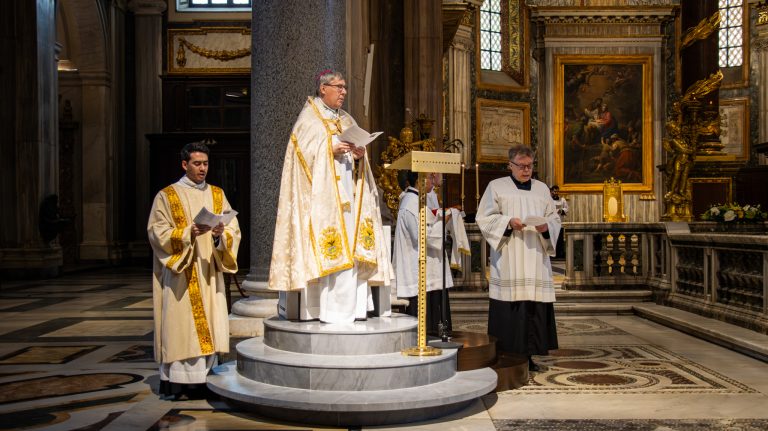
Catholics across Denmark are encouraged to attend Mass at their nearest parish this Sunday. Principal celebrations will be held at St. Ansgar’s Cathedral (Sankt Ansgars Kirke) on Bredgade 64, Copenhagen — the seat of Bishop Czesław Kozon and the principal church of the Diocese of Copenhagen.
Other notable parishes in Copenhagen include:
- Sacred Heart Church (Jesu Hjerte Kirke), Vesterbro — one of the city’s largest Catholic churches, inaugurated in 1895
- St. Augustine’s Church (Skt. Augustins Kirke), Østerbro — with English-language Masses
- Sakramentskirken, Nørrebro — English Masses on Sundays
Parishes are also active in Aalborg, Aarhus, Esbjerg, Odense, and across Jutland. For a full list of Mass times across Denmark, visit the diocesan website at katolsk.dk.
A Prayer for Denmark This Pinse
As Denmark enjoys its long weekend by the sea and in the countryside, Catholics here carry something the rest of the country has largely set aside: the knowledge of why there is a holiday at all.
The Holy Spirit who came at Pentecost has not departed. He is still at work — in the parishes of Copenhagen, in the small communities of Jutland, in the families who gather for Mass this Sunday morning before the rest of Denmark is out of bed.
Come, Holy Spirit. Renew the face of this earth — and of this country.
Mass times for Pentecost Sunday across Denmark: katolsk.dk